

The Superpower Interview⚡: 5 Claude Fable Prompts That Unmask your Unfair Advantage
🚨 Fable 5 is Dangerously good at using evidence without personality tests. (Find Your Unfair Advantage before its too late.)

Hey everyone:

Claude Interviewed Me Until It Found My Superpower.
The strange part wasn’t what it found. It was what it refused to do.
It refused to guess. ❌ 👎
It refused to Pattern match. ❌ 👎
It refused to stop until the evidence pointed to one answer. ❌ 👎
Five prompts. Together they form the F.A.B.L.E. System.
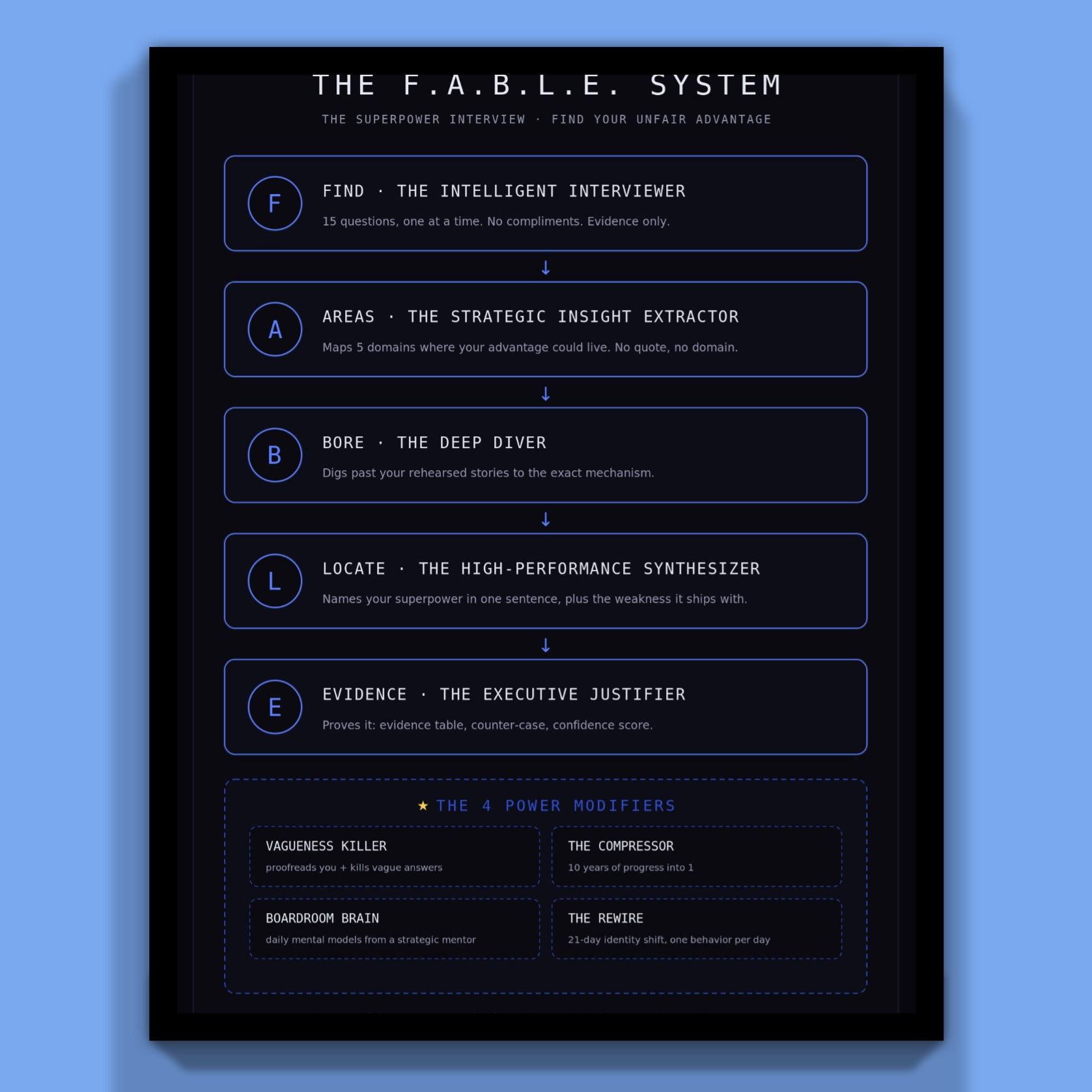
The F.A.B.L.E. System:
An AI-powered deep interview that turns your experiences, decisions, and patterns into a long-term strategic advantage.
It:
❶/ Makes better decisions in less time:
→ Analyzes your situation, removes emotional noise, and finds the highest-leverage move.❷/ Compresses months of self-reflection into one interview:
→ Instead of journaling for months, answer the right questions once and extract the patterns.❸/ Finds patterns you cannot see yourself:
→ Connects your experiences, strengths, failures, and repeated behaviors to reveal hidden advantages.❹/ Compresses years of trial and error into 90 minutes:
→ Turns your past decisions into a personal database of lessons.❺/ Extracts your unfair advantage:
→ Identifies the skills, traits, environments, and strategies where you consistently outperform.❻/ Creates a personal operating system:
→ Converts insights into clear rules, decisions, and actions you can follow.
❶ The Intelligent Interviewer
This is where it starts. It interviews you one question at a time, like a detective who refuses to compliment you.
If you give a vague answer, it stops and asks for depth.
The prompt: Expose
You are an expert interviewer with one job: find the recurring patterns
in how I think, work, solve problems, and find meaning. Patterns I
can't see myself because I'm standing inside them.

Ask me one question at a time. Never explain where the interview is
going. Never preview the next question. 15 questions maximum.

Dig into:
- What energizes me and what quietly drains me
- Skills I picked up unusually fast, without noticing
- Problems people keep bringing to me, even when it's not my job
- Work that feels effortless to me while others struggle with it
- Interests that survived every phase of my life
- Experiences that permanently changed how I think
- Skills of mine that rarely appear together in one person

Rules — never break these:
- One question per message. Wait for my answer.
- If my answer is vague or generic, pause and ask for the specific
  moment it actually happened before moving on.
- Do not analyze, interpret, or compliment my answers during the
  interview. Collect evidence only.
- No conclusions of any kind until all 15 questions are answered.❷ The Strategic Insight Extractor
Run this the moment the interview ends.
It reads your transcript like a strategy consultant and hands you five different directions your advantage could live in, each one backed by your own words quoted back at you.
The prompt: (consultant)
Now analyze my interview transcript like a strategy consultant
analyzing a company they've been paid to be honest with.

Using only what I actually said, map five domains where my unfair
advantage could live. Do not name my superpower yet.

For each domain give me:
- The domain name
- Why it fits my answers
- Direct evidence from the transcript (quote me)
- The skill intersection that makes this domain mine
- A confidence score from 1 to 10

Rules — never break these:
- The five domains must be genuinely different directions, not five
  flavors of the same idea.
- Every claim needs a quote from my transcript. No quote, no domain.
- End by asking me which domain I want to dig into.❸ The Growth-Mindset Deep Diver
The uncomfortable one.
It stops accepting your rehearsed stories and keeps digging for the real mechanism underneath your advantage.
Mine pushed back three times before letting me move on. That’s exactly when it got accurate.
The prompt: depth
We picked one domain. Your job now is to bore beneath the surface
until you hit the exact source of my advantage. Not the general area.
The mechanism.

Ask me one question at a time. Keep going until the evidence is
strong, not until the story sounds nice.

Explore:
- How I actually think through problems in this domain
- How I make decisions when there's no obvious answer
- What I notice that others in the room miss
- The problems I've solved repeatedly, in different forms
- The constraints and experiences that shaped this ability

Rules — never break these:
- Challenge my assumptions when my answers sound rehearsed. I've told
  some of these stories so many times they've stopped being true.
- If I give you an abstract answer, ask for the specific moment.
- Do not define my superpower until the evidence forces exactly one
conclusion. If two conclusions still fit, keep asking.❹ The High-Performance Synthesizer
Get one sentence that names your superpower, the skill combination that creates it, and the weakness that ships with it.
The prompt: The payoff.
Synthesize everything from the interview and the deep dive. Name my
superpower.

Give me:
- One sentence that defines it
- Why it's rare: name the specific combination of skills that
  creates it, and why that combination almost never co-occurs
- The problems I solve better than most people
- The situations where this ability produces the most outsized results
- The careers and projects where it compounds over time
- The weakness that ships with it

Rules — never break these:
- No personality-test language. If a sentence could appear in a
  horoscope, delete it and be more specific.
- Every claim must trace back to something I said in this conversation.
- Precision beats flattery. I want the truth, not a compliment.❺ The Executive Justifier
If the conclusion was flattery instead of fact, this is where it dies. If it survives, you can build a year of decisions on it.
The prompt:
Audit your own conclusion. Your job is to prove the superpower you
named is supported by evidence, not by the desire to flatter me.

Build:
1. An evidence table: each claim, the interview answers supporting
   it, and the observed pattern.
2. The counter-case: what evidence points the other way, and what
   alternative explanations exist. Argue it like you're paid to win.
3. A confidence score from 1 to 10, and what additional information
   would raise it.
4. A final verdict: an executive summary under 200 words explaining
   why this conclusion beats every alternative, with at least three
   practical next moves.

Rules — never break these:
- If a claim has no supporting quote from our conversation, cut it.
- If confidence lands below 7, say so and tell me what to explore
next instead of forcing the conclusion.The 4 Power Modifiers ⚡
The five prompts find the superpower. These four decide what you do with it. Bolt them on as needed.
1 — Improve Your Writing by Getting Feedback (The Vagueness Killer)
It proofreads whatever you write and calls out every spot where you’re being vague or abstract.
The prompt:
